Showing posts with label Devon & Somerset Fire & Rescue Authority. Show all posts

Sunday, 26 June 2022

Reckless decisions put more South West lives in danger

Cornwall

No rescue ladder at Launceston

Cornwall County Council's decision to remove the only fire engine with a long ladder (13.5 metres) from Launceston fire station was bizarre. I wanted to see the risk assessment that lay behind this decision, so I submitted a freedom of information request for details. Not only did they fail to respond in the time required by law, but they have not provided all the information.

One of several buildings in Launceston where a 13.5 metre ladder is needed

From the limited information they did provide it is very clear that they failed to carry out a proper risk assessment before removing this particular ladder. The only risk assessment they have provided is generic, and relates to the introduction of a specific type of new fire engines. The brief section refers to the inability of these fire engines to carry a 13.5 metre ladder and how they will have to carry a shorter 10.5 metre ladder instead.

Astonishingly, the risk assessment says that the likely harm or loss resulting from this is firefighters being unable to reach a casualty and:

Injury/death 

to personnel 

or public

Yet despite this, they go ahead with their reckless gamble. They naïvely suggest that the fire safety legislation, which only applies to certain buildings, and fire safety initiatives in the home, which don't reach everybody, are adequate control measures. They also try to justify this folly by saying these ladders are rarely used. In doing so they ignore the reality that they have no idea where or when one will next be needed to save a life.

It is even more astonishing when you realise that, in the recent past, Launceston firefighters rescued a woman in the nick of time using their 13.5 metre ladder. Without that ladder the woman would have died a horrible death, whilst firefighters stood helpless. 

A woman clinging to this chimney could only be reached with a 13.5 metre ladder

It is also disturbing that Cornwall Council, which claims to be "committed to open and transparent government", has refused to provide all the information they hold. The excuse, disclosure would "prejudice commercial interests", and they consider that more important than the public's right to know.

I suspect the real reason is that the information includes emails that cast doubt on this reckless decision. Cornwall Council clearly have something to hide. 

There is no commercial interest, 
but there is a strong public interest on a matter of life and death.

Devon & Somerset

Plymouth residents exposed to additional risk

The stupidity of replacing properly equipped fire engines with RIVs (Really Inadequate Vehicles) was illustrated again today, when Plymouth fire crews were dealing with a serious fire. Instead of fully equipped fire engines being sent to Greenbank fire station, which is the city's busiest, two RIVs were sent to provide inadequate protection to Plymouth residents. They came from Ashburton and Moretonhampstead where, until recently, both stations had been provided with fully equipped fire engines.


This is worse than the inadequate Cornwall changes, as the RIVs only carry 9 metre ladders, and it could have been even worse. Had it not been for public protest, the RIVs would only have been carrying 5 metre ladders! Even so, there are many buildings in Plymouth with occupied floors above 9 metres where, if a fire breaks out when Really Inadequate Vehicles are on standby, lives could be lost. 

The policy of removing fully equipped fire engines from many fire stations and replacing them with second class and third class vehicles is fundamentally flawed. The farce of today's inadequate cover was a predicted consequence of this reckless policy. It was recognised by experienced serving and retired firefighters, but conveniently dismissed by inept managers to cut costs. 

The people of Devon & Somerset deserve properly equipped fire engines, not inadequately equipped vans.

Animals in Devon better protected than people

Another recently highlighted inadequacy is the provision of Heavy Rescue Tenders in Devon. Heavy Rescue Tenders (HRT) carry equipment needed at more difficult and complex rescues, such as road traffic collisions (RTC) involving lorries, railway accidents, building collapses, and heavy machinery accidents. 

Much better provision for people in Somerset than in Devon

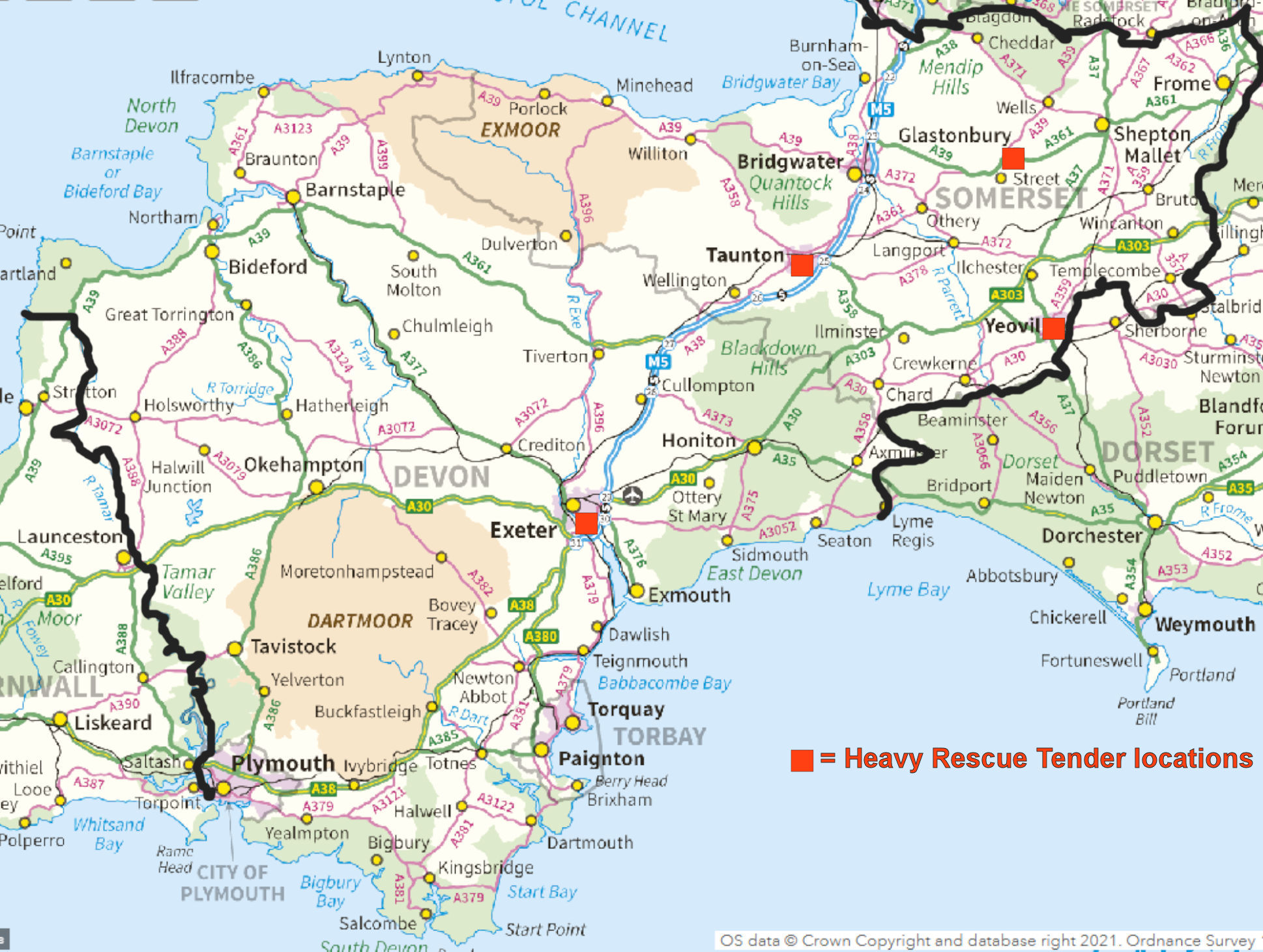
Devon is around double the size of Somerset and has more than double the number of people living there. Yet, there is only one Heavy Rescue Tender in Devon (at Middlemoor), whilst there are three in Somerset (Glastonbury, Taunton and Yeovil). It is even more illogical, as fire crews in Devon attend more road traffic collisions than fire crews in Somerset. 

Most of Devon without adequate Heavy Rescue Tender cover

A recent RTC in East Devon occurred whilst the Devon HRT was unavailable, so the HRT from Yeovil was sent. That distance was perhaps not too bad, but what if that RTC had been at Hartland, Ilfracombe, Plymouth or Tavistock? The golden hour, the optimum time to release trapped and injured casualties and get them into a hospital, would be more than used up just waiting for the HRT to arrive.

If animals get into difficulty in North or West Devon, specialist rescue vehicles and crews are available at Barnstaple and Plymouth. Yet people seriously trapped in those areas are dependent on the Heavy Rescue Tender from Exeter, or if that is unavailable, one of the Somerset ones.

DSFRS is clearly aware that this makes no sense, as they seek to justify the unjustifiable on their website. They say it is, "so that they can be close to the major road arteries entering and leaving the two counties, and to cover important road junctions within the counties". 

Are they really unaware of the the major road arteries between Cornwall and Devon (A30, A38 and A39), and do they not care about the many important road junctions in the other two thirds of Devon?

The discrepancy may pre-date the amalgamation of the two services, but failing to improve provision in the following 15 years is a continuing and unacceptable failure. 

Heavy Rescue Tender provision in Devon 
must be increased to the Somerset standard


Tuesday, 26 April 2022

Fire Authority stealth cuts put lives and property at risk

Ashburton area protection downgraded and more to follow

Just a couple of years after Ashburton residents successfully fought to save their fire station, the Conservative controlled fire & rescue authority has stabbed them in the back. In a secret move, Ashburton's properly equipped fire engine has been removed and replaced with a poorly equipped van.

The so called Rapid Intervention Vehicle (RIV) has previously 

been dubbed by firefighters as a 'Really Inadequate Vehicle'. 

Whilst a few fire stations are having their older fire engines replaced with new, fully equipped Medium Rescue Pumps (MRP), others are being downgraded. In recent years, the fire & rescue authority has replaced many proper fire engines with less capable Light Rescue Pumps (LRP). Compared to the MRP, the LRP effectively provides residents with a second class service, whilst the RIV only provides a third class service.

A report told Councillors about these inadequacies nearly five years ago, and the purchase of more RIVs was put on hold after local protests. However, since then they have bought another five, and they seem determined to blunder on and downgrade the protection offered to many communities. The report said: 

"LRP’s and RIV’s do not carry the same quantity of equipment carried by the MRP’s." 

The effect of downgrading from MRP to a RIV


How many buildings have windows that the 9-metre ladder can’t reach?

I don’t know, but worryingly, neither did the fire & rescue service when they chose the locations for RIVs. They have no idea how many lives are now at increased risk in the Ashburton area, or anywhere else.

DSFRS will claim that not many rescues are carried out with a 13.5 metre ladder (carried on the MRP). How often is irrelevant, they are still carried out from time to time, and no one knows when or where the next one will be. DSFRS excuses will be of no comfort to someone trapped by the next life threatening fire and, if they don't survive, it will be of even less comfort to family and friends of the victim.

Not only less water, but also less ability to obtain additional water for firefighting

As well as having less than half the water carried on a MRP, the RIVs are less well equipped to obtain additional supplies. With only half the hose on a MRP, more fires will see the RIV too far away from hydrant supplies. How many more? Again, the fire & rescue service failed to check, but a lot more buildings will be too far away. 

Without a portable pump, they cannot reach water supplies that are only accessible on foot. It was only last week when portable pumps were used at two fires. Near Staverton, two portable pumps were needed at a fire that could only be accessed on foot, and at Ilfracombe two portable pumps had to be used to boost water supplies at a major fire.


Even if there is access to open water, the 25% cut in the amount of suction hose carried on the RIV may mean it is still too far away to be used. 

Other equipment no longer carried, or reduced, includes

No Roof Ladder - which means firefighters cannot safely access the roof for rescue or firefighting. 

No Gas Tight Suits - no protection for firefighters from hazardous materials.

No Foam firefighters unable to fight fires involving flammable liquids.

No Winch - this reduces the ability to rescue people trapped in road crashes or in other hazardous situations.

No Positive Pressure Fan - unable to remove harmful smoke from burning buildings to improve visibility for rescue and firefighting.

Beaters reduced by 66% - With just two carried, and much less water available, the ability of firefighters to tackle wildland fires (field, gorse, grass, woodland etc.) is seriously reduced. 

Hosereels reduced by 50% - With just one hosereel, instead of two, this limits the ability of firefighters to stop fires spreading. It also halves the distance that can be reached from the vehicle. On a MRP, the second hose reel can be attached to the first to double the distance that can be reached.

Breathing Apparatus cut by 25% - For safety, firefighters wearing breathing apparatus sets must work in pairs, so the cut from four sets to three is, in practice, a 50% cut in operational capability.

The real risk

Nearly 8,000 people live in the area covered by Ashburton fire station, with many more visiting and travelling through the area on ordinary roads and the busy A38. The Ashburton crew also regularly go to other areas to provide assistance or to provide cover when local crews are committed. 

There was a perfect illustration of the folly of using RIVs last week, when Ashburton's RIV ended up in Plymouth to provide cover when all their crews were attending a serious fire. The RIV is inadequate for protecting people in and around Ashburton, so is totally inadequate for the significant risk in Plymouth. There are many taller residential buildings, where someone could easily be trapped beyond the reach of a 9 metre ladder, and there are significant risks in Plymouth, including the nationally important Royal Navy dockyard.

Will your area be next for 3rd class protection?

After the public outcry about fire station closures and the use of RIVs, all but one of the fire stations was saved and the fire engine replacement scheme was put on hold. It now seems that the Fire & Rescue Authority has secretly resumed replacing fully equipped fire engines with inadequately equipped vans.

A Freedom of Information request has already shown that claims they had properly risk assessed this flawed replacement policy were false. Councillors should have taken action against those responsible for the false claims. Claims that are now putting lives and property in greater danger. 

The 5 RIVs recently purchased brings the total to 20, but original plans were for 45. If that is implemented, there will be very long waits for vital equipment that is not carried on RIVs. The map below shows the original planned locations.


As per the plan, RIVs are now at Ashburton, Chard, Dartmouth, Ilfracombe, Kingston, Okehampton, Princetown, Tavistock, Teignmouth, Williton, Wells, and Woolacombe. Not in the plan, Moretonhampstead and Tiverton have also been allocated a Really Inadequate Vehicle. 

Councillors need to act to stop communities in Devon & Somerset being downgraded to 3rd class protection


Monday, 5 July 2021

Spin & deception continue. Are DSFRS planning to buy more Really Inadequate Vehicles?

On Friday I commented favourably on a Devon & Somerset Fire & Rescue Service tweet about their new Medium Rescue Pumps. 

However, it seems that Deputy Chief Fire Officer Joe Hassell did not like my reference to inadequately equipped vans. In his reply he repeated the deception that different sized appliances had been located according to "risk and geography". 


So I reminded him that they were unable to produce any evidence that they had properly risk assessed the change, either generically or specifically for stations that were to receive these 3rd class 'fire engines'. 


As for his unsubstantiated claim that firefighters and residents are 'fully supportive', you have to take that with a very large pinch of salt. Some people will always be fooled by spin, even some firefighters, and in any organisation there are always those who will agree with management to further their careers, or simply because they prefer a quiet life. 

Disagreeing with managers is always a risky option. That is especially so in DSFRS, where Her Majesty's Inspectorate of Constabulary and Fire & Rescue Services reported concerns, raised by more than a quarter of staff, about being bullied, harassed or discriminated against. The report specifically mentioned that some felt managers were "unwilling to be challenged or given an alternative view."

I would love to say that I came up with the description of the RIV as a Really Inadequate Vehicle, but credit for that goes to a Devon & Somerset firefighter.

So, I then gave Joe Hassell the benefit of the doubt and invited him to provide some evidence of proper assessment of the implications of having less well equipped and less capable vehicles.


I really want to share the evidence of proper risk assessments, of detailed risk v benefit analysis, of detailed studies of the actual risks in a station area, but, surprise, surprise, none have been provided. Instead, Joe chose to avoid the question completely.

Why he would imagine that looking round the RIVs would make any difference I don't know. They aren't suddenly going to grow bigger water tanks or sprout extra equipment. I am afraid this saga has all the hallmarks of someone in DSFRS having what they thought was a 'bright idea'. Save money by buying these cheaper vehicles, save more money by having less equipment on them, and spin the downgrading of protection by claiming they will be quicker and can get to places that Medium Rescue Pumps can't.

Nothing wrong with a 'bright idea' but a responsible service would properly assess the disadvantages, not just report potential advantages, and they would examine in detail the risks to the public and to firefighters of such a significant change.

DSFRS not only failed to do this, they misled the public and Councillors on the Fire & Rescue Authority by claiming they had done so.

It is quite true that there can be access problems, but RIVs offer a very limited advantage, especially as they have a bigger turning circle than some larger appliances. DSFRS already has Light 4x4 Pumps that can get into areas that cannot be accessed by larger appliances, including the RIVs.

Light 4x4 Pump

These can attend incidents with conventional fire appliances and transport firefighters and equipment when they reach a location where the larger appliance cannot proceed any further. They also have the added benefit of 4-wheel drive, so they can travel off road. The RIVs cannot.

Other fire & rescue services have managed to acquire more compact fire appliances that are not only more manoeuvrable than the RIVs, they also carry much more water and equipment. This is just one example.


The difference in width between the RIVs and some of the more compact appliances is a mere 12 centimetres, yet many of them will negotiate tighter bends and junctions than the RIVs can. That negligible width advantage may help at very few incidents, but at every incident firefighters will have less than half the water, half the hose, less breathing apparatus, no portable pump, no foam equipment for flammable liquid fires, and reduced levels of other equipment.


RIVs have been trialled by other English fire & rescue services and rejected, yet DSFRS foolishly ordered 15 without proper risk assessment or evaluation. Worryingly, the misled Fire & Rescue Authority originally approved the purchase of up to 45 RIVs. That was put on hold, but DCFO Joe Hassell's continuing spin, instead of evidence, raises concerns that they may want to purchase more. 

The people of Devon & Somerset, and their firefighters, should not be misled with spin, they deserve fully equipped fire appliances.

Monday, 3 May 2021

Who to vote for on Thursday if you value your life and the lives of others

If you want a fire & rescue service that keeps you safe, then your vote matters on the 6th of May. I am not a member of a political party and my vote is not guaranteed to any particular party. That is because none of them have policies that I am in full agreement with, so when I vote I consider the candidates, their policies, and their performance. 

Whilst campaigning in support of our fire & rescue services I have engaged with politicians, local and national, from every political party that will listen. The one conclusion I have come to though is that Conservative candidates do not deserve our support. Nationally and locally, they have done immense damage to our fire & rescue service and we are all less safe as a result. 

Please note that it is Devon County Council, Somerset County Council, Torbay Council and Plymouth City Council who appoint Councillors to the Devon & Somerset Fire & Rescue Authority. 

Conservative cuts = a slower and less effective response

Before you vote, here are a few things to consider about the damage Conservatives have already done to Devon & Somerset Fire & Rescue Service.


Wholetime Firefighters have been cut by over a quarter, which means greater reliance on Retained (On Call) Firefighters. They are not always available, and their numbers have also dropped by 14% over the last ten years. That means:

You are likely to wait longer for help to arrive as response times have been increasing, especially in rural areas.

When a fire engine arrives it is more likely that it will not have enough firefighters onboard to take effective action.

If you are lucky, that fire engine may be a fully equipped one.

If you are not lucky, it will be one with a reduced amount of water and equipment.

If you are really unlucky, it will be one that has a greatly reduced amount of water and equipment.

Does that postcode lottery make a difference? Not if it is a very minor incident, but if it is more serious, or lives are at risk, it can make the difference between a rescue and a life or lives being lost, and between a property being saved and a property being destroyed.

Significant cuts expose Plymouth residents to greater danger

Just look at how things have changed in Plymouth. Two fire engines used to arrive at property fires in most of Plymouth within five minutes. Now, with the exception of locations near Greenbank fire station, at best one may arrive in five minutes but the second will have to travel further and will take longer.

To make matters worse, the one remaining aerial appliance does not have a dedicated crew, which means that if the available firefighters are out on another call, another aerial appliance has to be sent from Torquay or Exeter. There are now just seven to cover the whole of Devon and Somerset, with no spares if one needs servicing or is defective.

Only today, two of the seven aerial fire appliances were needed at a fire in Exeter.

Photo from DevonLive report

None of the aerial fire appliances now has dedicated crews, which means that when needed the nearest may be sitting on the fire station unused, whilst another is sent from a station up to 60 miles away. Not much help if you are trapped beyond the reach of other fire service ladders.

The effect of the latest Conservative Cuts

The fire station at Budleigh Salterton has been closed and a total of nine frontline fire engines have been removed from the two counties.

When a third fire engine is required for a second or larger incident, in Bridgwater, Taunton, Torquay or Yeovil, it takes longer as it must travel from another town.

When a second fire engine is required for a second or larger incident, in Crediton, Lynton, Martock or Totnes, it takes longer as it must travel from another town.

Many other fire stations that have two fire engines are only able to crew one of them during the day. Some fire stations struggle to crew just one fire engine.

More Conservative cuts to come?

The public made clear that they did not want fire stations at Appledore, Ashburton, Colyton, Kingston, Porlock and Woolacombe to close. Fortunately, they did not close this year, but the Conservatives have not given any assurance that they are safe. They said they "will be subject to periodic review", which means the axe is still hanging over them.

There is also no assurance that 24x7 protection by Wholetime Firefighters at Barnstaple, Exmouth and Paignton is guaranteed. Plans for a less reliable and slower response in those areas are still a threat.

Nationally and locally the Conservatives have been happy to put the public and firefighters in greater danger with fewer fire stations, fire engines and firefighters. Their plans already indicate that, if they remain in control, things will only get worse.

Our Fire & Rescue Service is not safe in Conservative hands


.


Friday, 9 April 2021

Value your safety? Value your fire & rescue service? Then use your vote wisely on May 6th

 If you want a fire & rescue service that keeps you safe, then your vote matters on the 6th of May. Please make sure you are registered and that you use your vote in all the elections on that day. If you are already registered, make it easy to vote by applying for a postal vote, but please note that your completed application form must arrive by 20th April.


I am not a member of a political party and my vote is not guaranteed to any particular party. That is because none of them have policies that I am in full agreement with, so when I vote I consider the candidates, their policies and their performance. 

Whilst campaigning in support of our fire & rescue services I have engaged with politicians, local and national, from every political party that will listen. I have yet to decide which candidates will get my vote in May and I will not try to influence anyone else to vote for specific candidates or political parties. 

However, based on past performance, the one thing I am sure of is that I will not be voting for any Conservative candidates. That is because Conservative Government policies and Conservative Councillors on fire & rescue authorities have, over the last ten years, done immense damage to our fire & rescue service. 

As a result we are all less safe

Policies and decisions have not only been inept, they have been arrogantly steamrollered through with dishonest claims, unsubstantiated assurances and inadequate scrutiny.

Thanks to significant public protest in 2019, the cuts planned by the Conservative controlled Devon & Somerset Fire & Rescue Authority were watered down. Yet nine frontline fire engines have been removed, which means longer response times when an additional fire engine is required in those areas. For example, when a second fire engine and crew is needed in Lynton, for a second incident or to assist the first crew, it now has to travel at least 13 miles. Even more if the nearest crew is unavailable.

Unfortunately, you cannot directly vote for Members of the Devon & Somerset Fire & Rescue Authority, as they are Councillors appointed by Devon County Council, Somerset County Council, Torbay Council and Plymouth City Council. So, it is in elections for those councils that you should consider your vote wisely.

The threat to other fire stations has not gone away

The Conservatives made it quite clear that they have not abandoned plans to close Appledore, Ashburton, Colyton, Kingston, Porlock and Woolacombe. They said they "will be subject to periodic review", which means the axe is still hanging over them.

Conservative Councillors are also still trying to bully firefighters at Barnstaple, Exmouth and Paignton into accepting new shift systems that will increase response times at night in those areas. 

A shabby way to treat dedicated staff and wholly irresponsible 
to use the safety of the public as a bargaining chip in staff negotiations.

From Her Majesty's Inspectorate of Constabulary and Fire & Rescue Services inspection report

Third rate fire appliances


Conservative Councillors also approved the replacement of 45 fully equipped fire engines with inadequately equipped vans. They claimed that risk assessments had been carried out but there is no documentation to substantiate that claim. An investigation by the Information Commissioner found that not only were there no risk assessments, there were no reports, no memos, no emails, absolutely nothing to show that RIV locations were determined by the risk in those areas

This dishonesty was exposed after 15 Rapid Intervention Vehicles, dubbed Really Inadequate Vehicles by many firefighters, had been supplied. There are disturbing rumours that Conservative Councillors intend to increase the number of these third rate vehicles. Hampshire Fire & Rescue Service had similar plans but wisely decided to trial them before placing an order. They concluded they were inadequate and abandoned their plans in favour of more compact but well equipped fire engines.

The Conservative Government is now talking about taking the fire & rescue service away from fire & rescue authorities and giving control to Police & Crime Commissioners (PCC). There is no justification for this PCC empire building, and it will give the public even less of a say in how their fire & rescue services are run.

Conservatives, local and national, have already seriously undermined the ability of our firefighters to respond quickly and effectively when lives and property are in danger. Their plans will see that response get ever longer and less effective.

Fire & Rescue Services are not safe in Conservative hands

Wednesday, 2 December 2020

So who did DSFRS lie to? The public and councillors, or the Information Commissioner?

 Council tax consultation


There are 26% fewer immediate response firefighters protecting 

Devon & Somerset residents than there were ten years ago.

Before I look at Devon and Somerset Fire and Rescue Service's deception, I just wanted to remind people that there is a consultation running on the amount of council tax people pay towards the service (Consultation link).  

The consultation ends on the 18th December.

Unfortunately, as Government has continued to cut funding, despite expecting the service to take on more and more work, only a council tax increase will avoid further cuts to the service.

I would encourage people to carefully consider their answers to questions like, "How satisfied or dissatisfied are you with the service provided by Devon and Somerset Fire and Rescue Service" and "Thinking about your local fire and rescue service, do you think they have a good reputation". 

You may be very satisfied with your local firefighters, but less so with the service's senior management and the Fire Authority. You can be sure that both senior management and the Fire Authority will claim the credit for positive answers, even though you may be thinking of those at the sharp end when you answer. 

If that is the case, I would suggest selecting an answer that reflects your view of those at the top, and clarify in the  "What has influenced your answer?" box that you are satisfied with firefighters, control operators and others who actually provide the service to the public.

Fire service managers used misleading claims to justify significant cuts. 
Public pressure saved six fire stations from closure, 
but 8 fire engines are being removed from other fire stations. 

Who lied and who did they lie to?

Many will remember when DSFRS planned to replace around a third of their fully equipped fire engines with inadequately equipped vans. They called them Rapid Intervention Vehicles (RIV) and told Councillors and the public that their locations would be selected based on the risks in that area.

I had serious doubts that proper risk assessments could have justified such drastic changes, so in March 2018 I submitted a freedom of information request for details of the justification, and specifically requested copies of the risk assessments. Two months later some documents arrived, some of which had several sections redacted on quite spurious grounds, but there were no risk assessments. 

There then followed a lengthy process of complaints to the Information Commissioner. Last year she confirmed that Devon and Somerset Fire and Rescue Service had breached the Freedom of Information Act and ordered them to provide additional information, including some that had been unlawfully redacted. Some more information was forthcoming, but still no risk assessments.  

No assessment of the effect on the service's ability to deal with incidents with less water, less hose and less equipment, and not carrying certain equipment at all on these third rate vehicles. 

No assessment of the risks in the station areas they were to be allocated to. 

So I went back to the Commissioner and this year, after further correspondence with DSFRS, the Commissioner said that she had accepted the DSFRS claim that there was no other documentation. 

So, either DSFRS lied to the Information Commissioner, which is unlikely, or they never carried out the risk assessments that they told Councillors and the public that they had carried out.

Not only no risk assessments, but absolutely no documentation referring to the risk of replacing full sized fire engines with less capable vehicles, and no documentation about RIV locations being determined by the risk in that area. No reports, no memos, no emails, absolutely nothing. Yet despite this fundamental omission, they had placed an order for 15 RIVs, with an option for another 30

I find it astonishing that a fire & rescue service would embark on such a fundamental change without assessing the impact that would have, yet clearly that is what DSFRS did. Without assessments they had even decided where these vehicles and the supporting Incident Support Vehicles (carrying equipment not available on the RIVs) would be located. The locations were among the details they hid, until ordered by the Commissioner to reveal them, and you can see why. 

It reveals the true scale of their inept plans and how seriously reduced protection for residents would be. 

They now claim this plan was 'never adopted', but it would be more accurate to say that they have backtracked. The order for the other 30 RIVs is now on hold, hopefully to be abandoned completely. The plan shows very clearly that this was never about matching resources to risk, with RIVs scattered across the two counties at city, town and rural stations with a diverse range of risks. 

It is interesting to note that Hampshire Fire & Rescue Service looked at replacing a number of fire engines with very similar RIVs, but sensibly only ordered one to be trialled at a variety of stations. They found it unsuitable and have now abandoned the idea. 

Instead, to reduce the current size of their fire engines without sacrificing capability, they have chosen more compact fire engines that are narrower and shorter, but are far better equipped than DSFRS's RIVs. Just 12 centimetres wider, they carry nearly twice as much water and a lot more equipment. They can even turn tighter corners than the RIV's, as their turning circle is just 12.4 metres, whilst the RIV's is 13.7 metres.


The very few occasions when 12 centimetres less width will be an advantage can never make up for not having enough water and equipment at every incident, especially in a less manoeuvrable vehicle.

Councillors need to ask the Chief Fire Officer why proper risk assessments were not carried out and why they and the public were deceived.


Sunday, 19 January 2020

Report confirms cover up but DSFRS still in denial


Cuts reduced but some will wait longer for help to arrive

I was going to comment on the National Fire Chiefs Council investigation of the Cathedral Yard fire in Exeter earlier, but decided not to distract from the fight to stop the damaging cuts proposed by the Chief Fire Officer. The Fire & Rescue Authority decision was disappointing, as it will still result in some people having to wait longer for help to arrive. That the cuts were not worse had much to do with the steadfast efforts of local campaigners who exposed the misinformation and inaccuracies from Devious & Secretive Fire & Rescue Service.

BBC News

Campaigners must continue to monitor developments to make sure cuts are not sneaked back in, and the Authority must ensure that the Chief Fire Officer honours his improvement assurances. Many of them seemed little more than wishful thinking, so it will be interesting to see if claims about more prevention cutting the number of incidents and deaths actually materialise. 

It will also be interesting to see if availability and response times actually improve, as the latest national data shows they are progressively getting worse. The Chief Fire Officer must not be allowed to falsely claim improvement by using figures for inadequately crewed stations and appliances. 


For statistical purposes, a fire station with less than
four firefighters available must not be counted as available

First appliance response times must not be shown as met
until at least four firefighters have arrived at an incident

Unfortunately, we can't rely on the Fire & Rescue Authority to hold the Chief Fire Officer to account, so everyone needs to stay alert. The failures at the Cathedral Yard fire in Exeter are yet another illustration of how we cannot trust claims from DSFRS’s senior management.

The failure to save the Royal Clarence Hotel 


Unprecedented failure to stop fire spreading

The National Fire Chiefs Council report suggests that it was DSFRS publishing their report on this incident that generated questions about their response. It was not, it was their unprecedented failure to stop the fire spreading, even though they had plenty of time and resources to do so. Serving and retired firefighters, including some who attended the fire, and members of the public were asking questions long before that report was published.

However, the DSFRS report itself is clear evidence that they were trying to shift the blame and hide their failings. There was no mention in the report of the 81 items we now know were identified at the internal debrief. The only recommendations in the report were for building owners and for government. The DSFRS spin machine continued to hide their own failings and present the loss of the Royal Clarence Hotel as unavoidable. 

A shabby attempt to blame others for the loss of the Royal Clarence Hotel

The spin machine even went on to arrogantly claim that the NFCC report clears them of covering up their failures at this incident. The reality is that the NFCC report shows failures of tactics, deployment, communication, co-ordination, command & control and resourcing. DSFRS’s desperate attempts to keep details of how they responded to this fire from the public is another indication of a disgraceful cover up. Refusing key details in responses to Freedom of Information Act requests, by falsely claiming it would threaten national security, is a serious abuse of the legal exemptions. It is 'crying wolf’ and will undermine cases where there is a genuine risk to national security.

Royal Clarence Hotel could have been saved

The NFCC report says they cannot state "whether or not the RCH could have been saved had different actions or decision making taken place". So it is perfectly possible that it could have been saved with better tactics and decisions. We will never know for certain, but given that the report identified significant failures to properly check for fire spread, there is every possibility that it could have been saved.

Not only was there a failure to provide a continual watching brief in all areas of the Royal Clarence Hotel, there was a failure to even properly check every part of the hotel. Unfortunately, the NFCC report fails to point out that at incidents in such properties you need more than a watching brief, you actively have to search for hidden voids and open them up. Yet, despite knowing about hidden voids at the Royal Clarence Hotel long before the fire, DSFRS failed to carry out this fundamental task. 

The risk of fire travelling through hidden voids was first documented in the 1800s
How to detect and prevent it used to be part of basic firefighter training
Is it still today?

DSFRS state that they won’t put firefighters at risk to save property. Yet the report shows that firefighters were withdrawn from the Royal Clarence Hotel when there was little or no risk in most of the hotel, but sent back in later when the risk had increased significantly. At best this indicates poor dynamic risk assessment and at worst it is a shabby attempt to excuse their failure to deploy the appropriate tactics.

The NFCC report says that there was an absence of a common recognised information picture at this incident but does not establish if this was the result of poor communication, poor command, poor training or all three. Anyone who has studied this fire, and also read Dr Sabrina Cohen-Hatton's book, 'the heat of the moment', will see hints in the NFCC report of the unhelpful behaviours she identified during her research into fire service decision making under pressure. 

Sadly, at this incident, poor decisions are also evident
when there was little or no pressure

BBC 'Inside Out South West'

Warnings ignored

It is disappointing that the NFCC report plays down the importance of the sector 4 commander’s "critical information", simply because the fire broke through the roof in a different area to the area he marked on the floor plan. The sector 4 commander properly reported concerns and a need to take action, but the command team did not act to halt the fire’s progress through the hotel. Where the fire broke through is irrelevant. Knowing that fire was already in the hotel and knowing about the risk of fire spreading through hidden voids, the command team should have already had detecting and dealing with that risk very high on their list of priorities, but they did not. 


The sector 4 commander’s critical information should have been a wake up call,
but it became just another missed opportunity

The report fails to get at the root cause of this fundamental failing. Was it poor information sharing, was it poor training, or simply inept decision making? It certainly seems that the command team had taken their eye off the ball. They had failed to carry out basic checks, wrongly assumed they had control of the situation and were focused on things such as command structures and relief crew rotation. Important stuff, but all secondary to the primary task of stopping the fire spreading.

Why did the most senior officers not take responsibility?

The top 3 management levels

Despite this fire being the largest fire in Exeter since the Second World War, a Brigade Manager did not take charge and the NFCC report surprisingly fails to address this issue. The report also fails to address why an Area Manager did not take charge until more than three hours after the ‘make pumps 15’ message (indicating that 15 fire engines are required). 

Although a Brigade Manager did attend the scene, some two and a half hours after the fire started, he did not take charge and an unnamed Group Manager was left in charge of over 100 firefighters at a complex incident. It seems the Brigade Manager opted to move to the comfort of Gold Command at Police HQ, instead of taking responsibility for firefighting operations at the scene.

Now there are major incidents, such as those affecting a wide area, where the most senior fire & rescue service officer available should attend Gold Command, but a major fire in a city centre is not one of them. The most critical role for this incident was that of Incident Commander, so the most senior officer available should have taken on that role. At the scene he may have identified the need to properly check for hidden fire spread, but he can’t do that sitting at Police HQ.

I also don’t understand the preoccupation in the report with the major incident declaration, aside from it being another illustration of ineffective communication. The declaration of a major incident should have no effect on how the fire is being tackled. At a major fire it only has significant implications for other services and for inter-agency co-ordination away from the scene.

BBC 'Inside Out South West' questions still unanswered

Other deficiencies in the NFCC Report

The report refers to the increased requirement for water overwhelming the water supply at times, but then fails to point out that ensuring adequate water supplies is a fundamental part of managing a fire. This should have been foreseen and planned for. You don't wait for the problem to arise before acting, as that delays effective firefighting and allows the fire to spread.

The NFCC report says that the escalation of the fire at around 10:18 translated in to “a make up for further resources including specialist appliances (ALPs)", but then claims they "arrived shortly afterwards”. According to details finally released under freedom of information legislation, no further appliances were ordered to the incident until 11:04, with the first arriving more than an hour after the escalation and the last two arriving 2 hours and 20 minutes after. The reinforcing ALPs arrived 90 minutes and nearly four hours after the escalation. Hardly “shortly afterwards”, and a significant delay to effective operations. Aerial appliances should have been requested much earlier and deployed much more effectively.

The NFCC report fails to detail the 81 learning points that DSFRS claim to have addressed. If firefighters and the public are to be reassured that DSFRS really has learnt lessons from the failures at the Cathedral Yard fire, the learning points and actions must be published.

The NFCC report has raised as many questions as it has answered

The Fire & Rescue Authority must get to the
bottom of the cover up and the failures

Reckless decisions put more South West lives in danger

Cornwall No rescue ladder at Launceston Cornwall County Council's decision to remove the only fire engine with a long ladder (13.5 metre...