Showing posts with label Really Inadequate Vehicles. Show all posts

Sunday, 26 June 2022

Reckless decisions put more South West lives in danger

Cornwall

No rescue ladder at Launceston

Cornwall County Council's decision to remove the only fire engine with a long ladder (13.5 metres) from Launceston fire station was bizarre. I wanted to see the risk assessment that lay behind this decision, so I submitted a freedom of information request for details. Not only did they fail to respond in the time required by law, but they have not provided all the information.

One of several buildings in Launceston where a 13.5 metre ladder is needed

From the limited information they did provide it is very clear that they failed to carry out a proper risk assessment before removing this particular ladder. The only risk assessment they have provided is generic, and relates to the introduction of a specific type of new fire engines. The brief section refers to the inability of these fire engines to carry a 13.5 metre ladder and how they will have to carry a shorter 10.5 metre ladder instead.

Astonishingly, the risk assessment says that the likely harm or loss resulting from this is firefighters being unable to reach a casualty and:

Injury/death 

to personnel 

or public

Yet despite this, they go ahead with their reckless gamble. They naïvely suggest that the fire safety legislation, which only applies to certain buildings, and fire safety initiatives in the home, which don't reach everybody, are adequate control measures. They also try to justify this folly by saying these ladders are rarely used. In doing so they ignore the reality that they have no idea where or when one will next be needed to save a life.

It is even more astonishing when you realise that, in the recent past, Launceston firefighters rescued a woman in the nick of time using their 13.5 metre ladder. Without that ladder the woman would have died a horrible death, whilst firefighters stood helpless. 

A woman clinging to this chimney could only be reached with a 13.5 metre ladder

It is also disturbing that Cornwall Council, which claims to be "committed to open and transparent government", has refused to provide all the information they hold. The excuse, disclosure would "prejudice commercial interests", and they consider that more important than the public's right to know.

I suspect the real reason is that the information includes emails that cast doubt on this reckless decision. Cornwall Council clearly have something to hide. 

There is no commercial interest, 
but there is a strong public interest on a matter of life and death.

Devon & Somerset

Plymouth residents exposed to additional risk

The stupidity of replacing properly equipped fire engines with RIVs (Really Inadequate Vehicles) was illustrated again today, when Plymouth fire crews were dealing with a serious fire. Instead of fully equipped fire engines being sent to Greenbank fire station, which is the city's busiest, two RIVs were sent to provide inadequate protection to Plymouth residents. They came from Ashburton and Moretonhampstead where, until recently, both stations had been provided with fully equipped fire engines.


This is worse than the inadequate Cornwall changes, as the RIVs only carry 9 metre ladders, and it could have been even worse. Had it not been for public protest, the RIVs would only have been carrying 5 metre ladders! Even so, there are many buildings in Plymouth with occupied floors above 9 metres where, if a fire breaks out when Really Inadequate Vehicles are on standby, lives could be lost. 

The policy of removing fully equipped fire engines from many fire stations and replacing them with second class and third class vehicles is fundamentally flawed. The farce of today's inadequate cover was a predicted consequence of this reckless policy. It was recognised by experienced serving and retired firefighters, but conveniently dismissed by inept managers to cut costs. 

The people of Devon & Somerset deserve properly equipped fire engines, not inadequately equipped vans.

Animals in Devon better protected than people

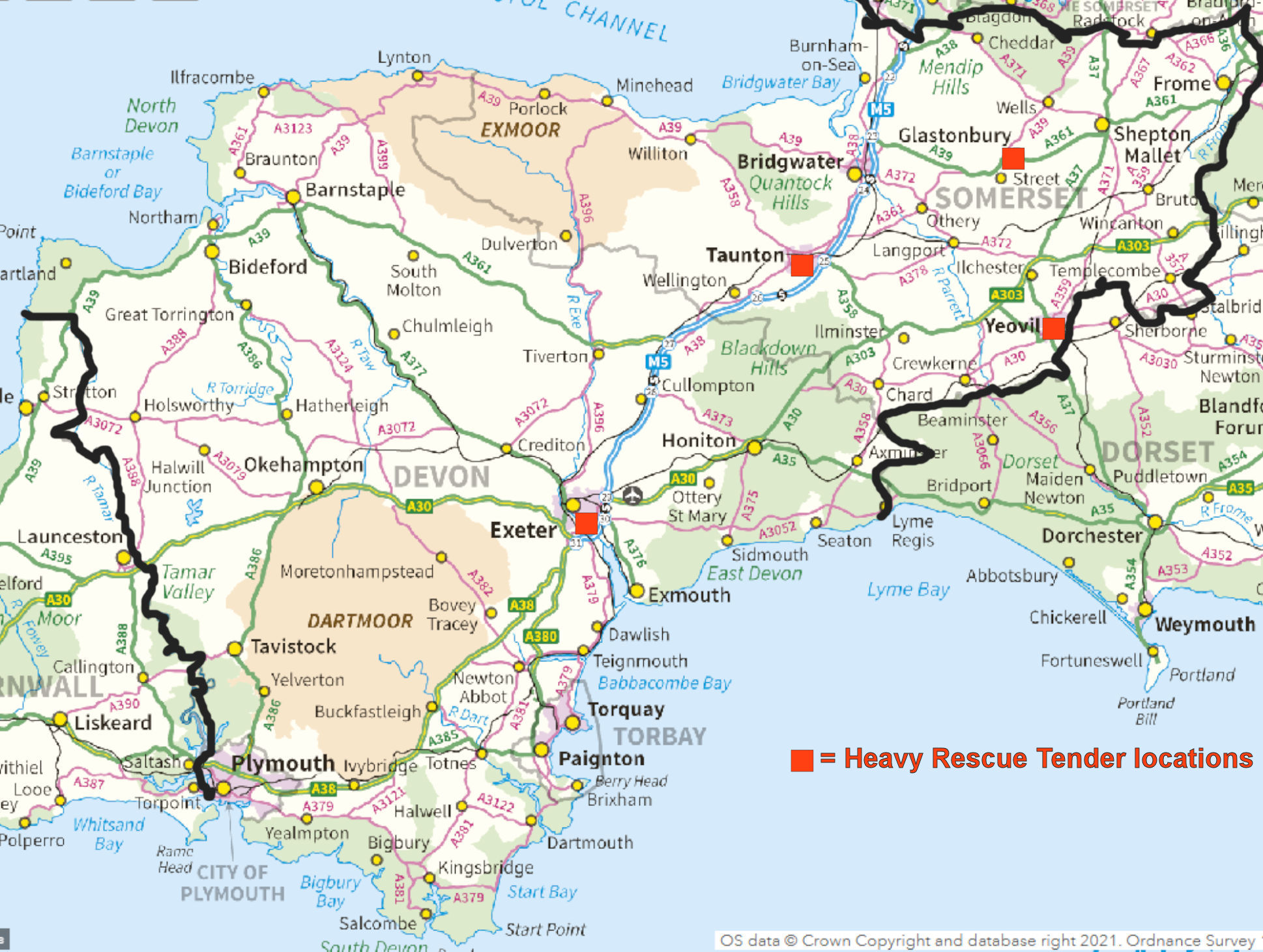
Another recently highlighted inadequacy is the provision of Heavy Rescue Tenders in Devon. Heavy Rescue Tenders (HRT) carry equipment needed at more difficult and complex rescues, such as road traffic collisions (RTC) involving lorries, railway accidents, building collapses, and heavy machinery accidents. 

Much better provision for people in Somerset than in Devon

Devon is around double the size of Somerset and has more than double the number of people living there. Yet, there is only one Heavy Rescue Tender in Devon (at Middlemoor), whilst there are three in Somerset (Glastonbury, Taunton and Yeovil). It is even more illogical, as fire crews in Devon attend more road traffic collisions than fire crews in Somerset. 

Most of Devon without adequate Heavy Rescue Tender cover

A recent RTC in East Devon occurred whilst the Devon HRT was unavailable, so the HRT from Yeovil was sent. That distance was perhaps not too bad, but what if that RTC had been at Hartland, Ilfracombe, Plymouth or Tavistock? The golden hour, the optimum time to release trapped and injured casualties and get them into a hospital, would be more than used up just waiting for the HRT to arrive.

If animals get into difficulty in North or West Devon, specialist rescue vehicles and crews are available at Barnstaple and Plymouth. Yet people seriously trapped in those areas are dependent on the Heavy Rescue Tender from Exeter, or if that is unavailable, one of the Somerset ones.

DSFRS is clearly aware that this makes no sense, as they seek to justify the unjustifiable on their website. They say it is, "so that they can be close to the major road arteries entering and leaving the two counties, and to cover important road junctions within the counties". 

Are they really unaware of the the major road arteries between Cornwall and Devon (A30, A38 and A39), and do they not care about the many important road junctions in the other two thirds of Devon?

The discrepancy may pre-date the amalgamation of the two services, but failing to improve provision in the following 15 years is a continuing and unacceptable failure. 

Heavy Rescue Tender provision in Devon 
must be increased to the Somerset standard


Tuesday, 26 April 2022

Fire Authority stealth cuts put lives and property at risk

Ashburton area protection downgraded and more to follow

Just a couple of years after Ashburton residents successfully fought to save their fire station, the Conservative controlled fire & rescue authority has stabbed them in the back. In a secret move, Ashburton's properly equipped fire engine has been removed and replaced with a poorly equipped van.

The so called Rapid Intervention Vehicle (RIV) has previously 

been dubbed by firefighters as a 'Really Inadequate Vehicle'. 

Whilst a few fire stations are having their older fire engines replaced with new, fully equipped Medium Rescue Pumps (MRP), others are being downgraded. In recent years, the fire & rescue authority has replaced many proper fire engines with less capable Light Rescue Pumps (LRP). Compared to the MRP, the LRP effectively provides residents with a second class service, whilst the RIV only provides a third class service.

A report told Councillors about these inadequacies nearly five years ago, and the purchase of more RIVs was put on hold after local protests. However, since then they have bought another five, and they seem determined to blunder on and downgrade the protection offered to many communities. The report said: 

"LRP’s and RIV’s do not carry the same quantity of equipment carried by the MRP’s." 

The effect of downgrading from MRP to a RIV


How many buildings have windows that the 9-metre ladder can’t reach?

I don’t know, but worryingly, neither did the fire & rescue service when they chose the locations for RIVs. They have no idea how many lives are now at increased risk in the Ashburton area, or anywhere else.

DSFRS will claim that not many rescues are carried out with a 13.5 metre ladder (carried on the MRP). How often is irrelevant, they are still carried out from time to time, and no one knows when or where the next one will be. DSFRS excuses will be of no comfort to someone trapped by the next life threatening fire and, if they don't survive, it will be of even less comfort to family and friends of the victim.

Not only less water, but also less ability to obtain additional water for firefighting

As well as having less than half the water carried on a MRP, the RIVs are less well equipped to obtain additional supplies. With only half the hose on a MRP, more fires will see the RIV too far away from hydrant supplies. How many more? Again, the fire & rescue service failed to check, but a lot more buildings will be too far away. 

Without a portable pump, they cannot reach water supplies that are only accessible on foot. It was only last week when portable pumps were used at two fires. Near Staverton, two portable pumps were needed at a fire that could only be accessed on foot, and at Ilfracombe two portable pumps had to be used to boost water supplies at a major fire.


Even if there is access to open water, the 25% cut in the amount of suction hose carried on the RIV may mean it is still too far away to be used. 

Other equipment no longer carried, or reduced, includes

No Roof Ladder - which means firefighters cannot safely access the roof for rescue or firefighting. 

No Gas Tight Suits - no protection for firefighters from hazardous materials.

No Foam firefighters unable to fight fires involving flammable liquids.

No Winch - this reduces the ability to rescue people trapped in road crashes or in other hazardous situations.

No Positive Pressure Fan - unable to remove harmful smoke from burning buildings to improve visibility for rescue and firefighting.

Beaters reduced by 66% - With just two carried, and much less water available, the ability of firefighters to tackle wildland fires (field, gorse, grass, woodland etc.) is seriously reduced. 

Hosereels reduced by 50% - With just one hosereel, instead of two, this limits the ability of firefighters to stop fires spreading. It also halves the distance that can be reached from the vehicle. On a MRP, the second hose reel can be attached to the first to double the distance that can be reached.

Breathing Apparatus cut by 25% - For safety, firefighters wearing breathing apparatus sets must work in pairs, so the cut from four sets to three is, in practice, a 50% cut in operational capability.

The real risk

Nearly 8,000 people live in the area covered by Ashburton fire station, with many more visiting and travelling through the area on ordinary roads and the busy A38. The Ashburton crew also regularly go to other areas to provide assistance or to provide cover when local crews are committed. 

There was a perfect illustration of the folly of using RIVs last week, when Ashburton's RIV ended up in Plymouth to provide cover when all their crews were attending a serious fire. The RIV is inadequate for protecting people in and around Ashburton, so is totally inadequate for the significant risk in Plymouth. There are many taller residential buildings, where someone could easily be trapped beyond the reach of a 9 metre ladder, and there are significant risks in Plymouth, including the nationally important Royal Navy dockyard.

Will your area be next for 3rd class protection?

After the public outcry about fire station closures and the use of RIVs, all but one of the fire stations was saved and the fire engine replacement scheme was put on hold. It now seems that the Fire & Rescue Authority has secretly resumed replacing fully equipped fire engines with inadequately equipped vans.

A Freedom of Information request has already shown that claims they had properly risk assessed this flawed replacement policy were false. Councillors should have taken action against those responsible for the false claims. Claims that are now putting lives and property in greater danger. 

The 5 RIVs recently purchased brings the total to 20, but original plans were for 45. If that is implemented, there will be very long waits for vital equipment that is not carried on RIVs. The map below shows the original planned locations.


As per the plan, RIVs are now at Ashburton, Chard, Dartmouth, Ilfracombe, Kingston, Okehampton, Princetown, Tavistock, Teignmouth, Williton, Wells, and Woolacombe. Not in the plan, Moretonhampstead and Tiverton have also been allocated a Really Inadequate Vehicle. 

Councillors need to act to stop communities in Devon & Somerset being downgraded to 3rd class protection


Monday, 5 July 2021

Spin & deception continue. Are DSFRS planning to buy more Really Inadequate Vehicles?

On Friday I commented favourably on a Devon & Somerset Fire & Rescue Service tweet about their new Medium Rescue Pumps. 

However, it seems that Deputy Chief Fire Officer Joe Hassell did not like my reference to inadequately equipped vans. In his reply he repeated the deception that different sized appliances had been located according to "risk and geography". 


So I reminded him that they were unable to produce any evidence that they had properly risk assessed the change, either generically or specifically for stations that were to receive these 3rd class 'fire engines'. 


As for his unsubstantiated claim that firefighters and residents are 'fully supportive', you have to take that with a very large pinch of salt. Some people will always be fooled by spin, even some firefighters, and in any organisation there are always those who will agree with management to further their careers, or simply because they prefer a quiet life. 

Disagreeing with managers is always a risky option. That is especially so in DSFRS, where Her Majesty's Inspectorate of Constabulary and Fire & Rescue Services reported concerns, raised by more than a quarter of staff, about being bullied, harassed or discriminated against. The report specifically mentioned that some felt managers were "unwilling to be challenged or given an alternative view."

I would love to say that I came up with the description of the RIV as a Really Inadequate Vehicle, but credit for that goes to a Devon & Somerset firefighter.

So, I then gave Joe Hassell the benefit of the doubt and invited him to provide some evidence of proper assessment of the implications of having less well equipped and less capable vehicles.


I really want to share the evidence of proper risk assessments, of detailed risk v benefit analysis, of detailed studies of the actual risks in a station area, but, surprise, surprise, none have been provided. Instead, Joe chose to avoid the question completely.

Why he would imagine that looking round the RIVs would make any difference I don't know. They aren't suddenly going to grow bigger water tanks or sprout extra equipment. I am afraid this saga has all the hallmarks of someone in DSFRS having what they thought was a 'bright idea'. Save money by buying these cheaper vehicles, save more money by having less equipment on them, and spin the downgrading of protection by claiming they will be quicker and can get to places that Medium Rescue Pumps can't.

Nothing wrong with a 'bright idea' but a responsible service would properly assess the disadvantages, not just report potential advantages, and they would examine in detail the risks to the public and to firefighters of such a significant change.

DSFRS not only failed to do this, they misled the public and Councillors on the Fire & Rescue Authority by claiming they had done so.

It is quite true that there can be access problems, but RIVs offer a very limited advantage, especially as they have a bigger turning circle than some larger appliances. DSFRS already has Light 4x4 Pumps that can get into areas that cannot be accessed by larger appliances, including the RIVs.

Light 4x4 Pump

These can attend incidents with conventional fire appliances and transport firefighters and equipment when they reach a location where the larger appliance cannot proceed any further. They also have the added benefit of 4-wheel drive, so they can travel off road. The RIVs cannot.

Other fire & rescue services have managed to acquire more compact fire appliances that are not only more manoeuvrable than the RIVs, they also carry much more water and equipment. This is just one example.


The difference in width between the RIVs and some of the more compact appliances is a mere 12 centimetres, yet many of them will negotiate tighter bends and junctions than the RIVs can. That negligible width advantage may help at very few incidents, but at every incident firefighters will have less than half the water, half the hose, less breathing apparatus, no portable pump, no foam equipment for flammable liquid fires, and reduced levels of other equipment.


RIVs have been trialled by other English fire & rescue services and rejected, yet DSFRS foolishly ordered 15 without proper risk assessment or evaluation. Worryingly, the misled Fire & Rescue Authority originally approved the purchase of up to 45 RIVs. That was put on hold, but DCFO Joe Hassell's continuing spin, instead of evidence, raises concerns that they may want to purchase more. 

The people of Devon & Somerset, and their firefighters, should not be misled with spin, they deserve fully equipped fire appliances.

Wednesday, 31 July 2019

Some Fire & Rescue Authorities properly protect the public and their firefighters

With Devon & Somerset Fire & Rescue Service providing less effective resources, and now planning to cut resources, it is worth looking at how other Fire & Rescue Services do more to protect their residents and firefighters.

Lincolnshire Fire & Rescue Service are providing 33 new and improved fire engines to better protect their communities. The comments in their video provide a stark contrast to the attitude of the Devon & Somerset Fire & Rescue Authority and the Chief Fire Officer towards firefighter and public safety.


Shame the Councillor called it a 'force', instead of a service, but you can't complain about 'best level of emergency response', 'important to provide the very best equipment', 'greater water supplies', and 'much more effective service'.

Then there is the Devon & Somerset Fire &
Rescue Authority's approach to 'duty to provide'.

Rapid Intervention Vehicles providing a poorer level of emergency response, 
less equipment, less water and a less effective service.


Now this is a Hampshire Fire & Rescue Service vehicle that is very similar to the Rapid Intervention Vehicles Devon & Somerset Fire & Rescue Service decided to buy. Unlike D&SF&RS, who decided to buy 45 with no idea where they were going to use them, Hampshire decided to extensively trial them first. 

Hampshire Fire & Rescue Service has now sensibly decided they 
are unreliable and inadequate. They have cancelled plans to buy 33. 

As well as buying these Really Inadequate Vehicles, Devon & Somerset Fire & Rescue Service now plans to close 8 fire stations, cut 16 fire engines and not crew another 14 fire engines during the day!

Residents and firefighters in Devon & Somerset deserve better!

Reckless decisions put more South West lives in danger

Cornwall No rescue ladder at Launceston Cornwall County Council's decision to remove the only fire engine with a long ladder (13.5 metre...